

Oily shine, visible pores and rough texture often come from different causes, so a carbon laser session cannot be judged by its immediate glow alone. You will learn how the carbon lotion and Q-switched Nd:YAG laser work, which changes are temporary, what risks and aftercare involve, and when another treatment is a better match.
Key takeaways
- Carbon lotion attracts surface oil and debris before laser energy removes it.
- The treatment can make pores look less visible without permanently shrinking them.
- It improves surface texture, but it cannot replace acne scars or deep wrinkles treatment.
- Disclose medications, active skin conditions, and recent procedures before booking.
What Happens During a Carbon Laser Treatment Session
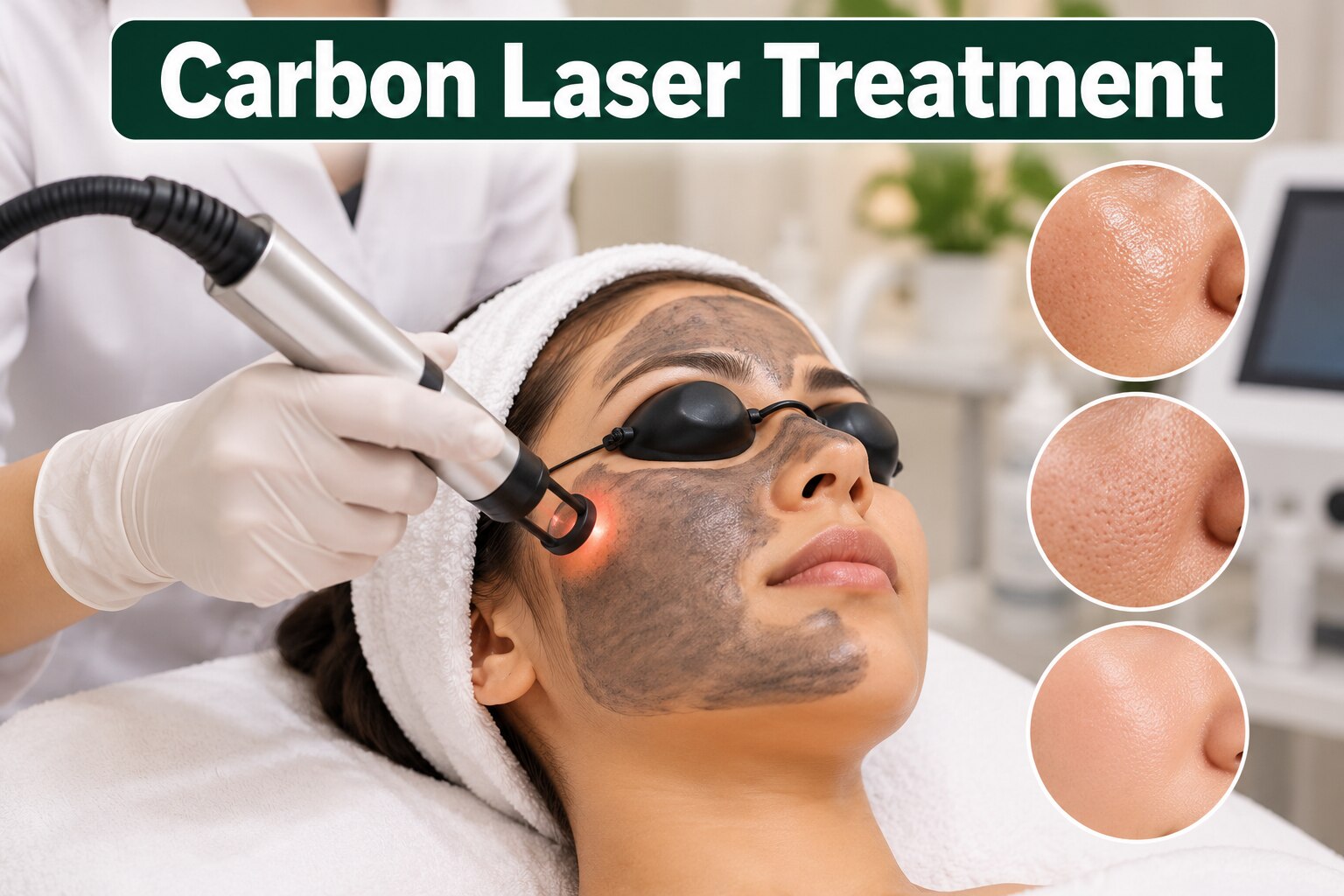
Carbon laser treatment combines a liquid carbon lotion with laser energy; the lotion is not the laser. In this carbon laser facial procedure, the dried carbon attracts surface oil and debris, while a Q-switched Nd:YAG laser rapidly fragments the carbon and lifts it from the skin.
The process is generally non-ablative, so it does not vaporize living skin.
A typical session follows these steps:
- The clinician cleanses the skin and checks for open wounds, active infection or significant inflammation. These problems require postponement.
- Protective eyewear is placed over your eyes because laser energy can cause ocular injury.
- A thin layer of carbon lotion is spread over the treatment area and allowed to dry.
- The operator makes controlled passes with a 1064 nm Nd:YAG laser. You may feel warmth, snapping or mild tingling as the laser heats and removes carbon particles.
- The remaining residue is wiped away, revealing skin with less surface oil and congestion.
- The clinician applies soothing skincare and broad-spectrum sunscreen before you leave.
Afterward, use gentle cleanser, moisturiser and sunscreen, and avoid picking or scrubbing treated skin. Temporary redness, warmth or dryness can occur. Carbon laser treatment does not permanently destroy sebaceous glands or shrink pore openings; oil production can return, so results usually require a planned series rather than one definitive session.
How It Helps Oily Skin and Makes Pores Look Less Visible
Carbon laser for oily skin can make the face look less shiny soon after treatment, but it does not seal pores or permanently switch off oil production. The liquid carbon layer binds surface oil and follicular debris; a Q-switched 1064-nm Nd:YAG laser then fragments the dried carbon so it can be wiped away.
The result is a cleaner surface, not a change to the pore’s underlying opening.
For carbon laser for enlarged pores, the key effect is visual. Excess sebum and debris can collect around a follicle, making its opening look darker and wider. Removing that buildup and lightly exfoliating the surface reduces congestion, so pores may look less visible.
Laser-related heat can also temporarily reduce activity in the sebaceous glands, but the glands remain present and resume producing oil. Oily skin can therefore return, requiring routine sebum-control skincare or maintenance sessions.
Pore size cannot be mechanically closed by this treatment. Structural changes in the skin and repeated follicular plugging also affect how large pores appear, so oil removal cannot correct every cause. Evidence for durable pore shrinking remains limited: studies of carbon peels commonly have small samples, short follow-up or combined treatments.
If the skin is inflamed, infected or irritated, treating the underlying condition takes priority; carbon laser is not a substitute for condition-specific care.
What It Can Improve in Skin Texture—and What It Cannot
A carbon peel can improve superficial roughness, fine flaking and a temporarily uneven feel. It may also make congestion-related unevenness and pore edges look less obvious after oil and debris are removed.
Think of carbon laser for skin texture as a surface-refreshing treatment: the carbon lotion is fragmented by Q-switched 1064-nm Nd:YAG laser energy, rather than living skin being vaporized.
| Treatment | Texture change it may provide | Main limitation |
|---|---|---|
| Carbon peel | Smoother surface, less visible congestion and a modest improvement in overall texture | Does not remove deep scar tissue or create strong collagen remodeling |
| Fractional laser resurfacing | More substantial remodeling of uneven texture and atrophic acne scars | More downtime, aftercare and pigment risk |
| Fractional CO2 or Er:YAG resurfacing | Deeper treatment for pronounced depressions and established acne scars | Greater inflammation and a higher risk of post-inflammatory hyperpigmentation |
Deeper acne scars need collagen-remodelling treatment when you can see pits, rolling depressions, sharp-edged boxcar scars or tethering that remains after cleansing and exfoliation. A carbon peel will not rebuild enough collagen to level those depressions; repeated sessions may only produce modest change.
A dermatologist can compare fractional laser resurfacing with microneedling, radiofrequency microneedling or fractional CO2 treatment according to scar depth, skin tone and pigment history. Inflamed acne, rosacea or dermatitis should be treated first, because irritated skin has a higher reaction and pigmentation risk.
Match the Treatment to the Actual Skin Concern
Look at the surface pattern and symptoms before choosing carbon laser treatment. Enlarged pores vs sebaceous filaments is the first distinction: pores are openings that look larger, while filaments are normal oil-and-cell contents that appear as fine, uniform grey or yellow dots, especially on the nose.
| Concern | What you see | What carbon laser treatment can do |
|---|---|---|
| Enlarged pores | Openings look more visible, often beside the nose or on oily cheeks | Reduce surface oil and congestion so pores look less prominent; it does not permanently shrink them |
| Sebaceous filaments | Small, evenly spaced dots that refill after cleansing and do not form a solid plug | Temporarily clear surface buildup; do not treat them as disease |
| Blackheads | Dark, firm plugs with a defined opening | Improve superficial congestion, but persistent blackheads need comedone-focused care |
| Comedonal acne | Repeated whiteheads or blackheads across an area, with few or no red lesions | Carbon treatment is not a substitute for an acne plan such as topical retinoid therapy |
| Inflammatory acne | Red, tender bumps, pustules or swelling | Postpone treatment on actively inflamed or infected skin and seek condition-specific care |
| Acne scars | Depressed pits or raised, firm marks left after acne heals | It may smooth mild surface roughness; deep scars usually need collagen-remodelling treatment, such as fractional resurfacing |
A carbon peel suits surface oil, mild congestion and uneven texture better than active inflammatory acne or deep scarring. Ask for an assessment if redness, burning, scaling or recurring painful lesions make the diagnosis uncertain.
Who Should Consider It, and How to Plan Safely
A carbon laser treatment candidate usually has oily, congested skin, visible sebaceous filaments or mild surface roughness, and realistic expectations about temporary refinement. It is not a substitute for treating comedonal acne, inflammatory acne, rosacea or dermatitis with condition-specific care.
Postpone treatment if you have:
- An active acne flare with painful inflammation, open sores or skin infection
- Sunburn, recent tanning, peeling or another procedure that has left skin sensitive
- An active cold sore near the treatment area
- Uncontrolled dermatitis or rosacea
Tell the clinician about isotretinoin use, photosensitising medicines, a history of keloid scars and previous reactions to lasers. Carbon laser side effects can include redness, warmth, dryness, temporary darkening and irritation; worsening inflammation requires review rather than another session.
Compare the plan by asking what problem it targets, how long improvement is expected to last, and what laser settings and treatment interval will be used. DIVINE AESTHETICS should be able to explain those choices rather than offer the same plan for every skin type.
Follow written laser treatment aftercare: use broad-spectrum sunscreen, avoid picking and pause irritating exfoliants until the skin settles.
| Option | Best fit | Main limitation |
|---|---|---|
| Carbon laser peel | Oil, superficial congestion and mild roughness | Temporary effect; limited evidence for lasting pore reduction |
| Prescription acne treatment | Comedonal or inflammatory acne | Requires consistent use and medical assessment |
| MNRF for acne scars | Depressed acne scars and collagen remodelling | More downtime, cost and sessions |
| Fractional CO2 or Er:YAG | Deeper textural scarring | Higher redness, pigment and recovery risks |
Related service
Corbon Lazer Service at Divine Aesthetics At Divine Aesthetics, our Corbon Lazer Service stands out as a premier solution for achieving flawless, radiant skin. View service → |
Frequently asked questions
What happens during a carbon laser treatment session?
A clinician applies liquid carbon to clean skin, lets it dry, and passes a Q-switched Nd:YAG laser over the area. The laser fragments the carbon so it lifts surface oil, debris, and dead skin cells.
How does carbon laser treatment help oily skin and visible pores?
The carbon absorbs surface oil and debris, while laser energy removes the carbon and exfoliated material. Cleaner pores can look less visible, but the treatment does not permanently shrink pore openings.
What can carbon laser treatment improve in skin texture?
It can smooth superficial roughness, remove surface buildup, and give skin a more even appearance. It cannot fully correct deep acne scars, pronounced wrinkles, or significant pigmentation on its own.
Who should consider carbon laser treatment, and how should they plan safely?
People concerned about oily skin, surface congestion, visible pores, or mild uneven texture can discuss it with a qualified clinician. Share your medical history, medications, skin-care products, recent tanning, active infections, and previous procedures before treatment.