
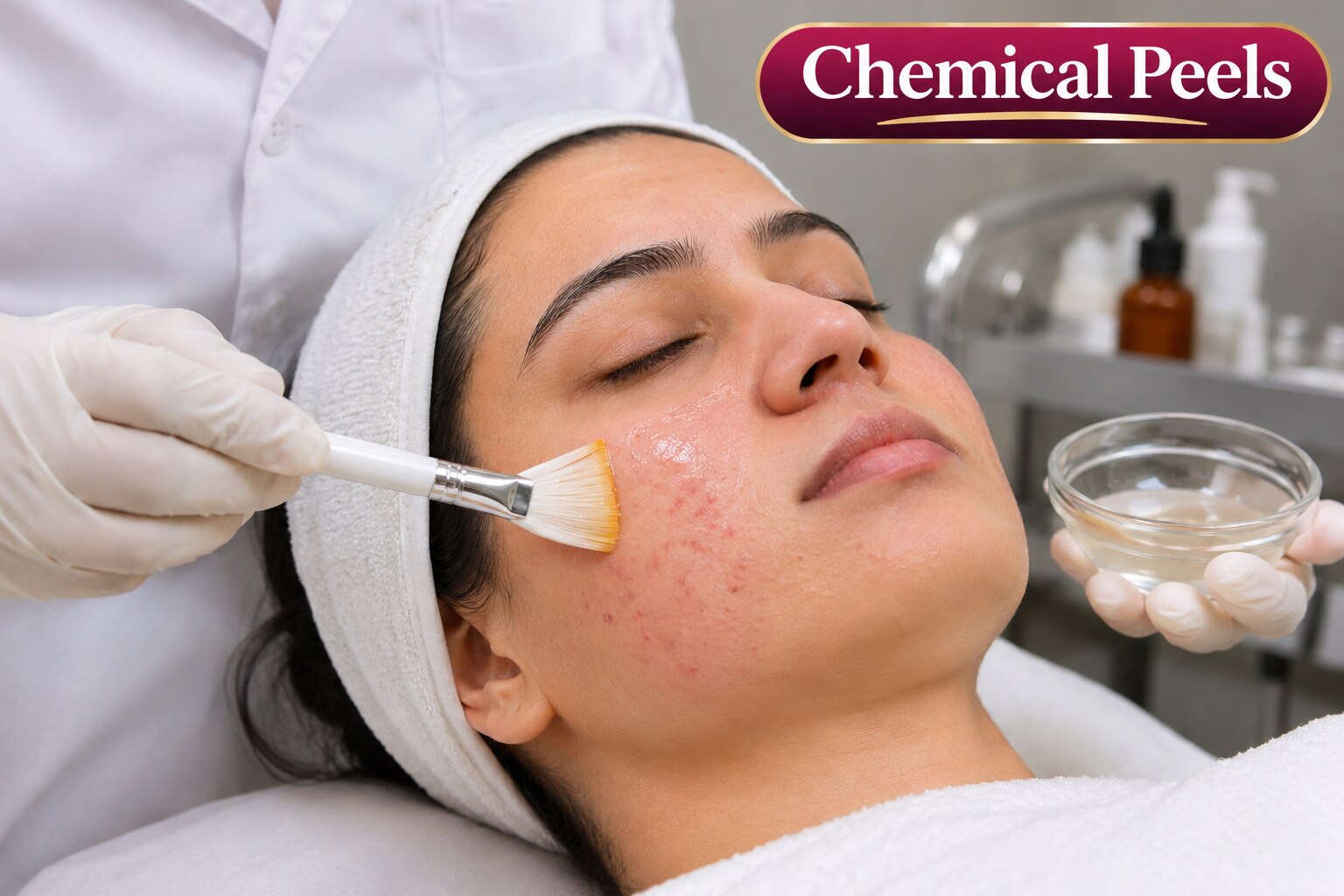
A flat brown mark, a depressed scar, active acne, and irritated skin can look similar at a glance but require different treatment decisions. By identifying the problem, matching peel depth to your skin and goals, and checking safety factors first, you can judge whether a peel is appropriate or whether another approach makes more sense.
Key takeaways
- Flat brown marks differ from indented scars and active irritation.
- Choose peel ingredients and depth based on the change you want to treat.
- Discuss skin tone, medical history, and current products before treatment.
- Plan recovery time and multiple sessions before deciding if a peel suits you.
Is the problem a flat acne mark, a scar, or active irritation?
Classify the change before choosing a peel: a flat mark, a change in skin depth, active acne, or irritation needs a different plan. Post-inflammatory hyperpigmentation appears as flat brown or gray discoloration; post-inflammatory erythema is flat red or pink discoloration. Melasma forms broader, symmetrical patches, often on the cheeks, forehead, upper lip, or nose.
| Finding | What it suggests | What a peel can do |
|---|---|---|
| Flat brown, gray, red, or pink area | Post-inflammatory hyperpigmentation or post-inflammatory erythema | May improve superficial discoloration |
| Broad, symmetrical facial patches | Melasma rather than an isolated acne mark | Needs diagnosis and pigment-focused planning |
| Ice-pick, rolling, or boxcar depression | Atrophic acne scars with altered skin depth | Cannot reliably restore lost volume |
| Papules, pustules, nodules, or cysts | Ongoing acne, not a finished mark | Requires acne control before scar treatment |
Roughness can result from clogged pores, shallow textural change, dryness, or dermatitis, so have a clinician examine uneven skin instead of labelling every area acne scars. A peel may smooth mild surface irregularity, but it cannot replace missing volume in a deep scar. Microneedling, laser treatment, subcision, and punch techniques are separate scar-treatment decisions.
Postpone treatment over cystic acne, open wounds, eczema, dermatitis, sunburn, active herpes simplex, or a weakened skin barrier. Treating compromised skin can intensify inflammation, infection, pigment change, or scarring.
Which peel ingredients and depths fit the pattern you want to treat?
Match the peel to the pattern: clogged pores and active acne point toward salicylic acid, while superficial discoloration or roughness may suit an alpha-hydroxy acid. A peel will not replace an acne-control plan; new lesions can create new marks.
| Option | Best fit | Recovery and limits |
|---|---|---|
| Salicylic acid peel | Oil-soluble, comedolytic, anti-inflammatory treatment for clogged pores, acne, and rough texture | Usually superficial, with limited downtime; it does not control the underlying acne alone |
| Glycolic acid peel | Superficial roughness and discoloration | Usually fine scaling and short disruption; a series is often needed |
| Lactic acid peel | A gentler surface treatment for mild uneven tone or texture | Usually less aggressive recovery; results still depend on repeated sessions |
| Mandelic acid peel | Uneven tone and texture when slower-penetrating alpha-hydroxy acid is preferred | Surface peeling is usually limited, but improvement is gradual |
| Jessner’s solution | A professional combination of resorcinol, salicylic acid, and lactic acid | Requires assessment because layering and endpoint affect injury depth |
| Medium-depth TCA peel | Deeper discoloration or texture concerns selected after examination | More peeling and recovery, with greater risks of prolonged redness, infection, scarring, and pigment change |
Superficial peels mainly affect the epidermis, so they usually create less downtime but often require a series. TCA strength cannot be judged from percentage alone: formulation, skin preparation, number of coats, pressure, and the visible endpoint all change penetration. A stronger peel is not automatically better for mild marks.
How do skin tone, medical history, and current products change the choice?
Skin tone, medical history, and current products determine a peel’s depth, timing, and preparation. Fitzpatrick skin types IV-VI and any personal post-inflammatory hyperpigmentation risk require conservative planning because darkening or lightening after a peel can persist.
| Risk factor | Safer planning | Why it matters |
|---|---|---|
| Fitzpatrick skin types IV-VI | Superficial peel, test area, staged sessions | Pigment change can be prolonged |
| Previous post-inflammatory hyperpigmentation | Conservative strength and strict broad-spectrum sunscreen | Irritation can trigger new uneven color |
| Recent isotretinoin or poor healing | Individual medical assessment before treatment | Healing risk depends on drug history and procedure depth |
Before treatment, give the clinician this checklist:
- Current acne medicines; topical or oral retinoids; benzoyl peroxide; and exfoliating acids
- Recent waxing, laser treatment, or other resurfacing
- Allergies, pregnancy or breastfeeding, and prior peel reactions
- Cold-sore history, because resurfacing can trigger recurrence and require antiviral planning
- Keloid formation, poor wound healing, immunosuppression, and recent isotretinoin use
Recent isotretinoin has no single universally correct waiting period for every procedure. The treating clinician must assess the dose history, treatment depth, and healing risks.
Use broad-spectrum sunscreen exactly as directed after treatment. Ultraviolet exposure can worsen pigmentation and irritate peeling skin, undermining the result. A deeper peel is not automatically better when pigment stability matters.
What happens during a peel, and what will your skin look and feel like afterward?
A chemical peel procedure begins with cleansing and degreasing to remove oil, makeup, and residue. The clinician then protects the skin around your eyes, nostrils, and lips before applying the selected solution for a measured period.
Expect stinging, warmth, or burning during application. Report severe pain immediately. The clinician watches the peel endpoint, then performs neutralisation when that formulation requires it; not every peel is neutralised in the same way.
| Depth | Immediate appearance | Chemical peel recovery |
|---|---|---|
| Superficial | Redness, tightness, and fine scaling | Shorter disruption; peeling may be subtle |
| Medium-depth | Stronger redness and more obvious peeling | Longer recovery with greater pigment and scarring risk |
Afterward, redness, tightness, scaling, and flaking can develop. Temporary darkening or lightening is also possible, especially if you develop post-inflammatory hyperpigmentation. Superficial peels usually cause finer scaling and less disruption than medium-depth peels, while medium-depth treatment can produce marked peeling and a longer recovery.
Seek medical review for persistent redness, blistering, severe pain, thick crusting, or pus. These are not normal cosmetic endpoints and can indicate a burn or infection.
Do not recreate professional treatment at home with high-concentration TCA, glycolic acid, salicylic acid, or lactic acid. The U.S. Food and Drug Administration warns that unsupervised use can cause chemical burns, infection, pigment change, and scarring.
How should you plan sessions and decide whether a peel is worth it?
A worthwhile plan treats chemical peel sessions as a series, not a one-time correction. The peel treatment interval depends on the ingredient, concentration, skin response, and whether irritation has fully settled, so request a written schedule rather than a promise of a fixed result.
| Option | Likely benefit | Main limitation |
|---|---|---|
| Superficial peel | Early surface shedding can make texture look smoother | Pigmentation usually needs repeated treatments and daily broad-spectrum sunscreen |
| Medium-depth TCA peel | Reaches deeper for selected concerns | Longer recovery and greater risk of prolonged redness, pigment change, infection, or scarring |
| Deep atrophic scar treatment | Requires scar-specific procedures | Increasing peel strength cannot remove a deep depression in one visit |
New acne lesions can create new marks, so acne control belongs in the plan. Ask which clinician-selected option fits you: a retinoid, benzoyl peroxide, salicylic acid, hormonal treatment, or another medicine.
Before booking, ask:
- Which diagnosis are you treating: active acne, flat discoloration, or a depressed scar?
- Why do this ingredient and depth fit my skin tone?
- What endpoint will you monitor during application?
- What is the plan if my pigment darkens?
- Which alternative, including scar-specific procedures, would you recommend?
At Divine Aesthetics in Mahalakshmi Layout, Bengaluru, use the consultation to keep those three problems separate instead of accepting one peel for all of them. A provider who cannot explain the schedule, endpoint, recovery, and backup plan has not given you enough information to judge whether treatment is worth the time and risk.
Related services
Chemical Peel At Divine Aesthetics, our Chemical Peel service offers a rejuvenating and transformative skincare experience designed to enhance your natural beauty. View service → |
Yellow Peel Service Description from Divine Aesthetics At Divine Aesthetics, we proudly offer the transformative Yellow Peel, a cutting-edge chemical peel... View service → |
Frequently asked questions
How can you tell an acne mark from an acne scar or irritation?
Post-inflammatory hyperpigmentation is flat brown or gray discoloration, while post-inflammatory erythema is flat red or pink discoloration. A scar changes skin depth, and active irritation causes ongoing redness, burning, scaling, or tenderness.
Which peel ingredients and depths are used for acne marks and rough texture?
The choice depends on the problem, skin condition, and treatment goal. Superficial peels address surface discoloration and roughness with less recovery; deeper peels increase recovery and risk, so a qualified professional must select the formula and strength.
How do skin tone, medical history, and skincare products affect peel choice?
Darker skin tones have a higher risk of post-inflammatory hyperpigmentation after irritation. Tell the provider about melasma, eczema, cold sores, pregnancy, medications, recent procedures, and products containing retinoids, benzoyl peroxide, or exfoliating acids.
What should you expect during and after a chemical peel?
You may feel warmth, tingling, or stinging during application. Afterward, expect temporary redness, tightness, dryness, or peeling, depending on the peel depth. Follow the aftercare plan, avoid picking, and use broad-spectrum sunscreen.
Related services
Acne marks treatment At Divine Aesthetics, we specialize in providing advanced and comprehensive treatments to effectively reduce and eliminate acne marks, helping you... View service → |
Black Peel Divine Aesthetics: Black Peel Service At Divine Aesthetics, we are proud to offer our specialized Black Peel treatment, designed to rejuvenate and... View service → |
Acne treatment At Divine Aesthetics, we offer comprehensive acne treatment services designed to address both the symptoms and root causes of acne, providing you... View service → |
Pigmentation treatment At Divine Aesthetics, we offer advanced pigmentation treatments tailored to address various skin concerns, from sunspots and age spots to melasma and... View service → |